Edna Annie Crichton: ‘the little woman with the heart of a lion’, 1876- 1970
Juliet Burton
Some stories are too good to be cut down! Juliet, one of this year’s Heritage Hunters, has researched the life of Edna Annie Crichton, the first female Lord Mayor of York. You can find an abridged version of her article in our printed magazine, and read on below for the full extended version.
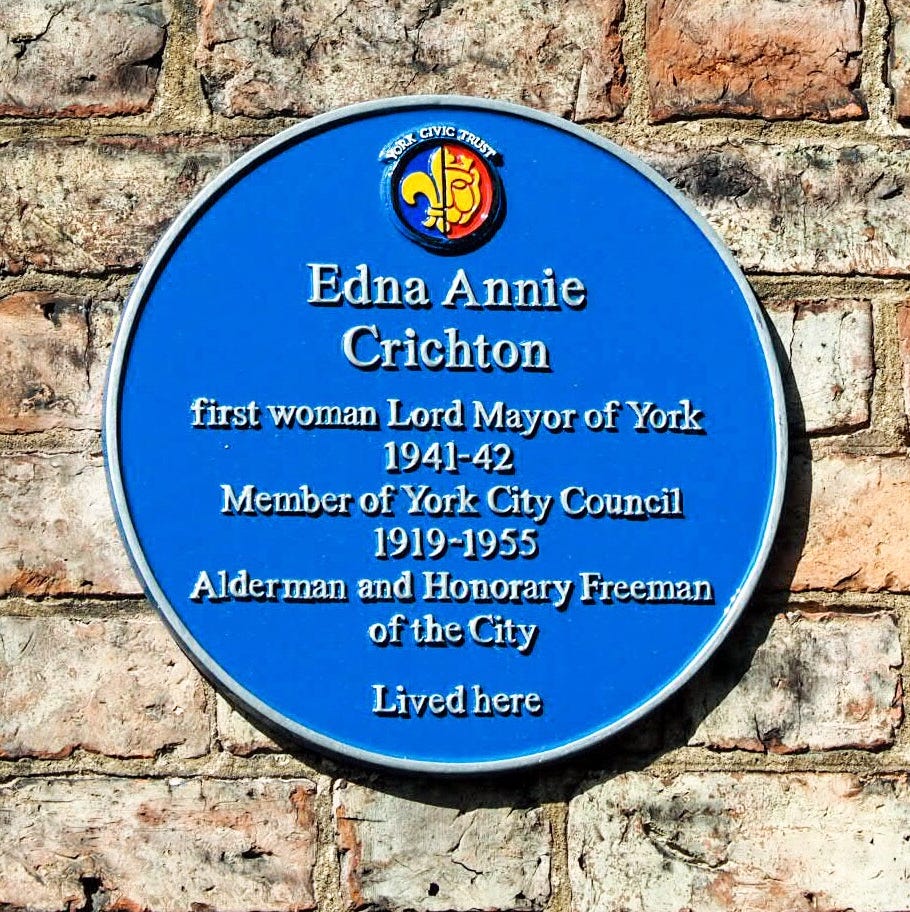
There is a blue plaque on a house in Clifton which pays tribute to a remarkable woman: Edna Annie Crichton, Lord Mayor of York, who lived in Clifton for 69 years.
Edna was the first female Lord Mayor of York and only the second woman to be given the honorary Freedom of York. She served on the York City Council for 23 years and then 13 more years as the first female Alderman in York. She never forgot her duty, even in the face of significant personal tragedy and adversity. Many people in Clifton remember her because of Crichton Avenue, but more on that later.
The early years
Edna Annie Crichton was born Edna Annie Sturge on 8th May 1876 in Barton St. Mary in Gloucestershire. She came from a Quaker family with a history of political involvement particularly in pacifism and in the abolition of slavery. Her father is described a ‘corn merchant’s clerk’ in the 1881 census.1 Her mother came from Montserrat where the Sturge family had had an estate (without involvement in the slave trade). Edna was the youngest of four children with one older brother, Charles and two sisters: Mary (known as May), and Vida.
Edna was an artistic and ‘sporty’ child but probably not very academic.2 She attended Sidcot School, a Quaker School, in Somerset, but notably, failed later to get into The Mount School in York where her sister May went and where her cousin, Francis, was a teacher and later a long serving headteacher, and another cousin, Millicent was later head of the juniors. Nevertheless, this meant that she already had a connection with York through May.
After leaving school, Edna worked in London at the Passmore Edwards Settlement (now the Mary Ward Settlement), a social welfare organisation that provided education, health and free legal aid services to deprived communities. Edna met her husband David Sprunt Crichton when he was sub-warden at Mansfield Settlement nearby. David Sprunt was from Dundee but grew up in Barrow-in-Furness. He had been educated in Edinburgh and in Mansfield College, Oxford. In addition to being passionate about education and welfare, he was a very keen cricketer and all round sportsman.
Married life
Edna and David married in the Quaker Meeting House at Charlbury, Gloucestershire on 22nd August 1901. David was not a Quaker but he appears to have become fully immersed in the Quaker community. David was already working as First Welfare officer at the Rowntree Cocoa Works, so the couple moved immediately to York where they lived at 37 St Mary’s. David was involved in the welfare reforms of Joseph and Seebohm Rowntree within the cocoa factory. He encouraged sporting activities such as the Rowntree’s football team and athletics; supported the choral societies, and amateur dramatics; and was a founding member of Rowntree’s in-house journal, the CWM (Cocoa Works Magazine). The Crichtons mixed regularly with the Rowntree family, who also lived in Clifton. David was an active member of the City Council Education Committee and spoke all over the country on education reform.
Edna was also active in social welfare. She served 6 years on the health insurance distribution committee from 1911 and then on the York Board for Poor Law Guardians until 1922. She was member of the Quaker Clifford Street Meeting House (now Friargate). Records show that she was a member of small number of committees but her voice is ‘largely absent from minute books’.3 Throughout her life she was staunchly proud of being a Quaker, her children were brought up as Quakers and it appears that David also embraced the Quaker faith.
In the meantime the couple had two children. Vida Mary Sturge Crichton was born on 15 August 1902. David Sturge Crichton followed on 30 October 1906. Both children were registered at their birth with the junior school of the Mount School. Vida then went to Sidcot School in Somerset, following in her mother’s footsteps, and David to Leighton Park in Reading, also a Quaker school. Both children went to Oxford University.
Vida worked in York for the Joseph Rowntree Social Service Trust and was active in supporting Seebohm Rowntree in collecting data for his second great survey on poverty. She went on to work for the Westminster Group of newspapers, whose chairman was John Bowes Morrell. JB Morrell had married Edna’s childhood friend Bertha Spence so the two families were very close.
David attended Edinburgh University after Oxford. He was sporty and athletic like his parents and went to Carnegie College of Physical Education in Leeds before becoming a PE teacher at Oakham School in Leicestershire (also a Quaker School). He played hockey for the Scottish national team. In 1939, just before war broke out, he obtained a post in Manchester University as organiser of PE.
The 1911 census sees Edna and David at home with the children and two people described as ‘servants’, so it seems they were comfortably well off.4
Political life begins
In 1919, Edna stood for election to the City Council for the first time. She had become a leading figure in the new Women Citizens’ Association ‘designed to help educate women into a new role in public life’,5 with her friend Almyra Gray (wife of the Lord Mayor Edward Gray of Gray’s Court) educating women for full participation in public office. Edna stood for election on a platform of housing, education and health – the three interests she stuck with for the rest of her political life.
Only one other woman was elected that year and she did not remain for long in the council. Only 5 women, including Edna, were elected to the City Council between 1919 and 1938. Not only was it unusual that she had won as an independent candidate, but she was also the first woman in the country, put forward as a candidate by a women’s organisation and then successfully elected.6 She stood staunchly for women’s views and women’s voices, believing that women knew more about matters such as housing, education, maternity, and child welfare than did men.
Edna represented the Bootham Ward. At the time there were only 6 wards in York and Bootham covered Clifton, Bootham, and the Groves.
Tragedy strikes
On 21st January 1921, David Sprunt Crichton, Edna’s husband, died suddenly. They had been married for just 19 years. He was 51 years old. Although, according to his sister in law May, he had died of postwar influenza as the result of ‘wartime strains’, It seems that he had been suffering from ‘indifferent health’ for only a fortnight and ‘he had visited at the house of a friend on Sunday evening, but after his return home he was taken ill and he died within about half an hour’.7 The shock for Edna and the two children must have been considerable. Although not born and brought up a Quaker, David was buried at the Quaker burial ground at the Retreat. Seebohm Rowntree spoke at his funeral and messages of sympathy came from the great and the good: the Archbishop of York, the Duke of York (later George VI), the Vice Chancellor of Leeds University, the Lord Mayor of York and York Head Teachers Association.
And here we come to Crichton Avenue. Because the avenue built later in the 1920s was not named for Edna; it was named for David. The Housing Committee minutes oi 16th December 1929 state that the street was to be named after him because ‘his name is so highly honoured in that district‘.8
1920s and 30s
In spite of her loss and while bringing up two children, Edna continued as a councillor. She established a separate Housing Committee while maintaining her place on the Health and – for a short while - the Education Committee.
In 1922 Edna was re-elected to the Bootham ward. By 1925 the wards had split and there were 12 wards in York. Edna was elected unopposed to the smaller Clifton ward. It seems that all parties agreed that housing ‘was a sphere which was essentially that of a woman, […] in which it would be folly to throw aside the experience Mrs Crichton (had) gained, […] which (demanded) that there should be continuity’.9 There was, therefore, cross-party agreement that no one would stand against her.
Edna’s association with the Rowntree family and factory continued after David’s death. She gave a reading at Joseph Rowntree’s memorial service in the Cocoa Works.
‘One of the readings delivered by Mrs. Crichton was John Wilhelm Rowntree’s “Love and Death” […] John Wilhelm was Joseph’s oldest son who had passed away in 1905, aged only 37.’10
She was invited to formally open the Joseph Rowntree Memorial Library in 1928.
But Edna also had to make a living and after David’s death. The 1921 census puts her at St Mary’s with just one other person, described as a ‘servant’.11 Subsequent electoral registers, however, see two and then three other people living there with her, almost certainly as lodgers since she wouldn’t have had the means to take on that many servants. One of these lodgers was Marian Prout, who was a close friend, possibly from school days, since Marian grew up in Somerset and Gloucestershire..
Electoral registers from the late 1920s and early 1930s refer to Edna still living at 37 St Mary’s, although she had now also acquired number 36. From 1926 she is listed at numbers 36 and 37 St. Mary’s but the list specifies that her ‘abode’ was at ‘2, St. Peter’s’ and she is separately listed at 2 St. Peter’s Terrace with her son David and at least two other couples.12 This ‘abode’ at ‘2, St Peter’s’ continues to be listed until the 1933 register when she is listed at 30, Clifton.13 On closer examination of the registers it appears that 2 St Peter’s Terrace is the same as 30 Clifton, since Edna had the same neighbours at both throughout. St Peter’s Terrace was probably the name of that row of houses.
Marian Prout remained at 36-37 St Mary’s and it seems likely that she may have managed the boarding house on Edna’s behalf although Edna herself was quite an ‘astute business woman’.14
Edna lived at 30 Clifton, not only with 3 lodgers (possibly one was a domestic help) but her son David Sturge Crichton is also listed as living there on the Electoral Register.15 This appears to be the years during which he was at Leeds Carnegie so maybe living at home. The house may have been divided into different floors or flats. There is a reference to visiting ‘Edna’s flat’ in the diary of a friend.16
In 1934 and in 1937 Edna was again elected for the Clifton Ward with a massive majority. In the 1937 election she beat her only opponent 2 to 1 and was supported by both the Liberals and the Conservatives in spite of insisting on maintaining her independence. Her focus was specifically on housing. There was a huge slum clearance programme ongoing. Four thousand houses had already been built during Edna’s time, many of them in Clifton, and another 1000 planned imminently. It is said that Edna visited every family in a house that was to be demolished as part of the slum clearance.17
It was surprising to find in shipping manifests that, in a break from the norm, in 1935, Edna and Marian Prout, took a holiday to New York. Records show them leaving on the Cunard White Star Line Aquitania from Southampton to New York on 9th October,18 and returning over a month later on 18th November on the Cunard White Star Line Laconia from New York to Liverpool.19 Neither woman is listed as having an occupation so it appears that this trip may have been for pleasure. Marian had become a good friend of Edna’s as evidenced when she died in 1954 and left everything to Edna and Edna’s daughter Vida.
A year later in 1936 Edna was appointed as a Justice of the Peace, or a magistrate. On 23rd November 1936, the Leeds Mercury reported on the new appointment of magistrates and described her as:
‘the first and […] only woman member of the City Council’ and a ‘prominent social worker’.20
The war years and Lord Mayor of York
The 1939 register (compiled to replace the missing 1931 census and the uncompiled 1941 census), indicates that Edna lived with 4 other people. Two of them were clerks at the cocoa works and one a bank clerk. Names have been written in, crossed out and replaced with other names which suggests fairly fluid situation with changing tenants. The fourth person, a woman, was listed as a ‘caretaker/domestic duties’ but as she appears to be well into her 70s by this time it was perhaps Edna who looked after her, rather than the other way round.21
Edna chaired a number of committees created to deal with war issues including the:
On Sites and Emergency Sub-committee – dealing with contamination by poisonous gas at Fishergate and Poppleton Schools
Billeting Committee
Apparatus Committee - dealing with emergency kitchens
Feeding committee – price of food, rationing etc.
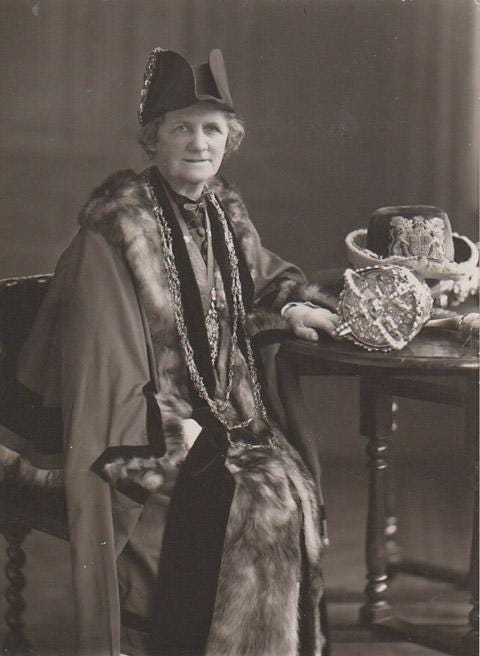
On the 8th September 1941 Edna became the first female Lord Mayor of York in 700 years. The exceptional circumstances of the war meant that Edna was accepted without the usual committee meeting.
The news was widely reported in the press, with the Yorkshire Post stating that Edna was ‘presented by the women of York with the scarlet gown, richly trimmed with fur, which becomes her civic dress for the year’ and expressing particular concern about the cost of the materials at a time of rationing.22 No doubt Edna and the ‘women of York’ ensured that the gown was made using as few clothing coupons as possible.
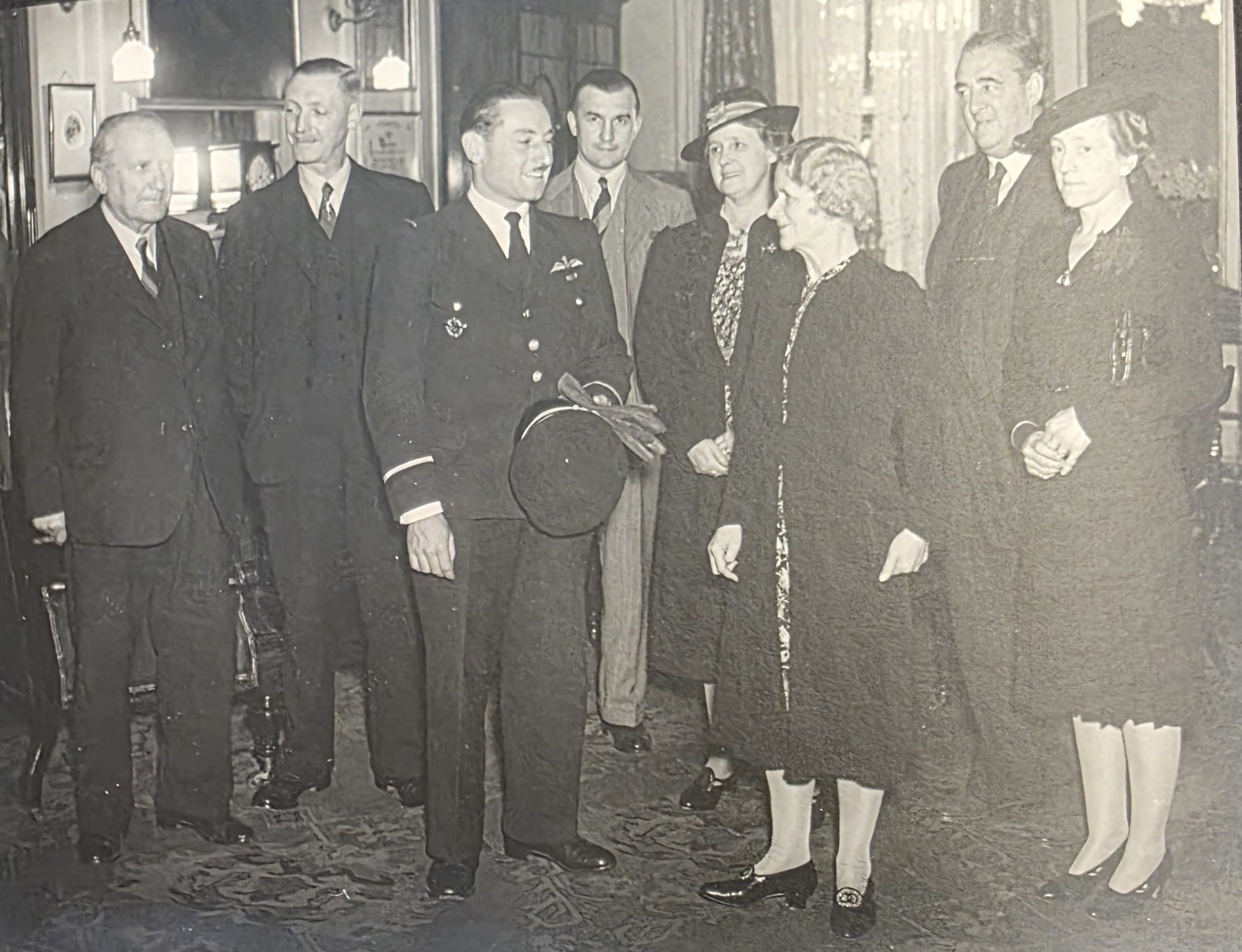
This was a testing time for Edna as a Quaker with a firm belief in pacifism, but she was able to focus on the objective of the war being to ‘win the peace – a just peace’.23 However, she was to pay a personal price as, along with the telegrams of congratulations, there was a telegram telling her that her son David had died on 29th August in hospital in a prison camp in Friesburg near Munich. David had been captured at Dunkirk in 1940 and had become ill in captivity. He left behind not only his mother and sister but also a fiancée, Sheila Hamilton Mackay, in Scotland who he had met at Edinburgh University. The last letter that he wrote was his proposal to her and it was Edna who informed Sheila of David’s death.24 As the mother of a prisoner of war, Edna was already Chair of the Prisoner of War Relatives Club. This news was an unexpected blow.
Edna dealt with her grief by continuing her work. She was still chairing the Housing Committee and attending a variety of other committee meetings. This was in addition to carrying out her Mayoral duties.
In the early morning of 29th April 1942, Edna faced one of her biggest professional challenges when York was hit by an air raid as part of the Baedeker Blitz which targeted cultural rather than military sites. The destruction across the city was significant with major damage in Edna’s own Clifton and Bootham areas, along with Leeman Road and Poppleton Road. The Burton Stone housing estate was particularly badly hit. Edna was living in the Mansion House which was damaged and the Guildhall just behind it was destroyed. Edna’s own house in Clifton also suffered damage. Edna’s own house in Clifton also suffered damage. Up to a third of homes across the city were destroyed or damaged. Over 94 people died and nearly 300 were injured.25
Edna took immediate charge, having the control room set up in the Mansion House. Edna is listed as an Air Raid Protection (ARP) Officer in the 1939 register so she will have been trained to deal with crises like these, although this will have been beyond anyone’s expectations.
The York Evening Press reported that she was:
‘an inspiration to its citizens […] working untiringly for about 18 hours, superintending ARP arrangements, visiting hospitals, and first aid points and generally alleviating distress among the victims.’26
Edna personally visited victims of the raids in Clifton and in other parts of York. She established the Lord Mayor’s Air Raid Distress Fund which raised more than £10,000 from which grants were dispensed immediately. Those families in houses which had been destroyed or damaged had their rent suspended or reduced. The council rehoused 981 applicants for new houses within 4 months. Clifton Councillor H.E Harrowell told the Council:
‘There is, to my mind, one individual who ought not to wait for an acknowledgement of the magnificent example and service which was set to the city, and that is the Lord Mayor.’27
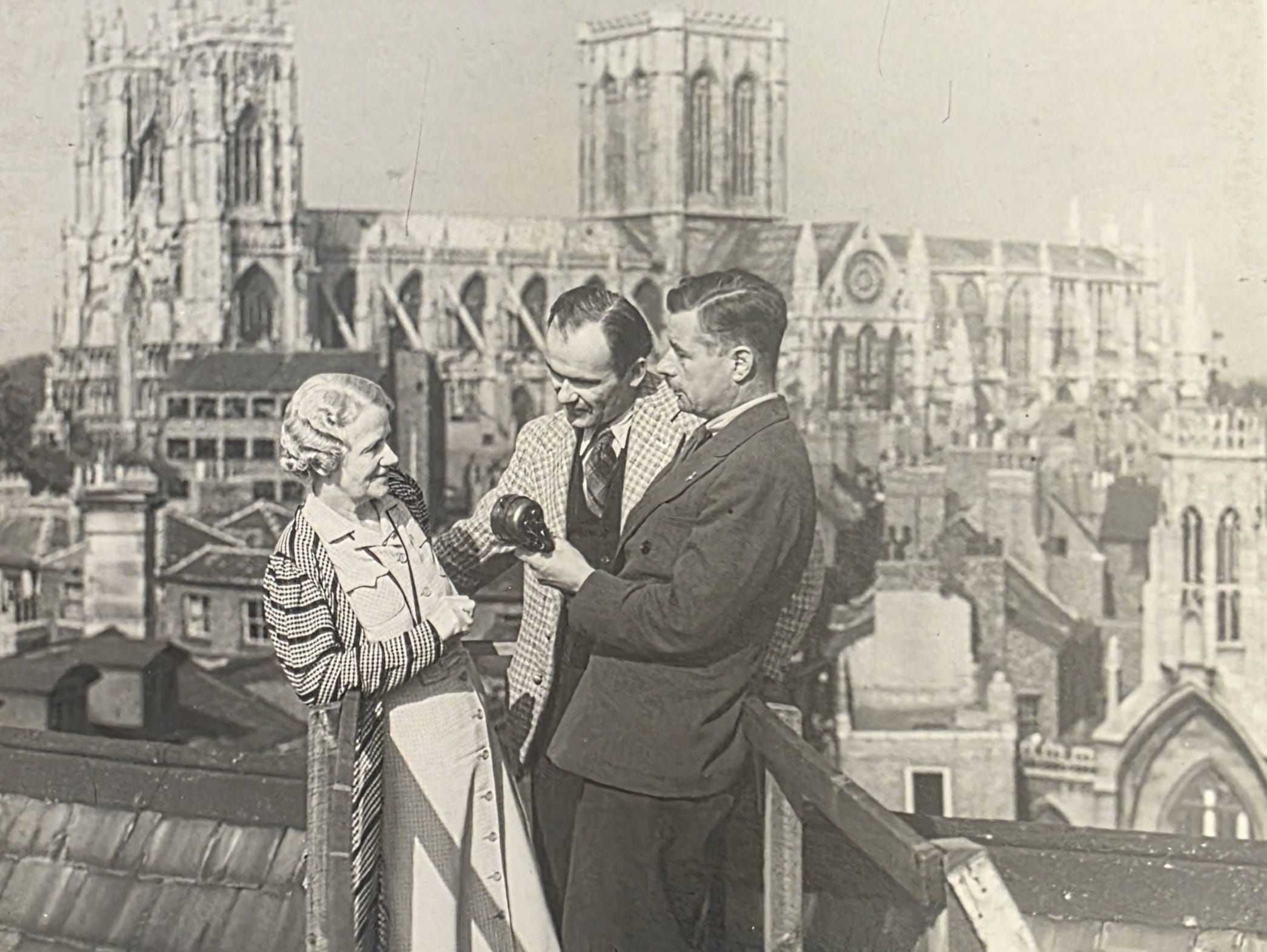
Edna was incensed when the BBC broadcast that the Minster had been spared during the raids. She sent a telegram saying that she believed that this would make the Minster a prime target for later raids. (It didn’t) Nevertheless, this did not stop her broadcasting to Canada with a view of the Minster behind her to show that it had been spared, although not until September that year when, perhaps, she thought it was safe.
In 1942 Edna was elected as the first female alderman in York having missed out by one vote 5 years earlier. In October that year she conferred the Freedom of the City on William Temple, the Archbishop of Canterbury (previously of York.) Edna’s speech was typically full of praise for Dr Temple as a man who recognised the rights of women and the unity of the Christian churches.28 She spoke as a woman and a Quaker.
The aftermath of war
Edan remained a councillor for 10 more years after the end of the war in 1945. The postwar period became more difficult for Edna as an independent, as the growth of party political politics took over. However, she made no secret of not being happy to lose her role (temporarily) as Chair of the Housing Committee to a Labour councillor. ‘I do not like being turned out of the chair […] Why would I?’29 With changing politics she was soon back in the role and voicing her strong views about the ‘flimsy’ prefab houses that had been provided by central government at the extortionate cost of £100 each. Edna wanted the government to provide funding and permission to build permanent housing instead.
Having served longer than any other councillor, she became ‘Mother of the Council’ in 1950 (the name – ‘Mother’ or ‘Father’ officially given to the longest serving council member) and deputy to JB Morrell when the Deputy Lord Mayor William Dobbie died.
Some of Edna’s ideas and proposals were less welcome than they had been in the pre-war years. In 1953 she suggested that council building programmes were not the answer to slum clearances. She proposed subsidising people to buy their own homes which could be privately built. In 1954 she nearly caused a riot with her proposal that council rents be increased but that rebates be provided on a means tested basis. Neither the suggestion of the increase nor the means testing were received well and Edna had to be escorted from the Guildhall through crowds gathered in St Sampson’s Square for her own safety. In 1955 she lost her role as Chair of the Housing Committee once more.
The later years
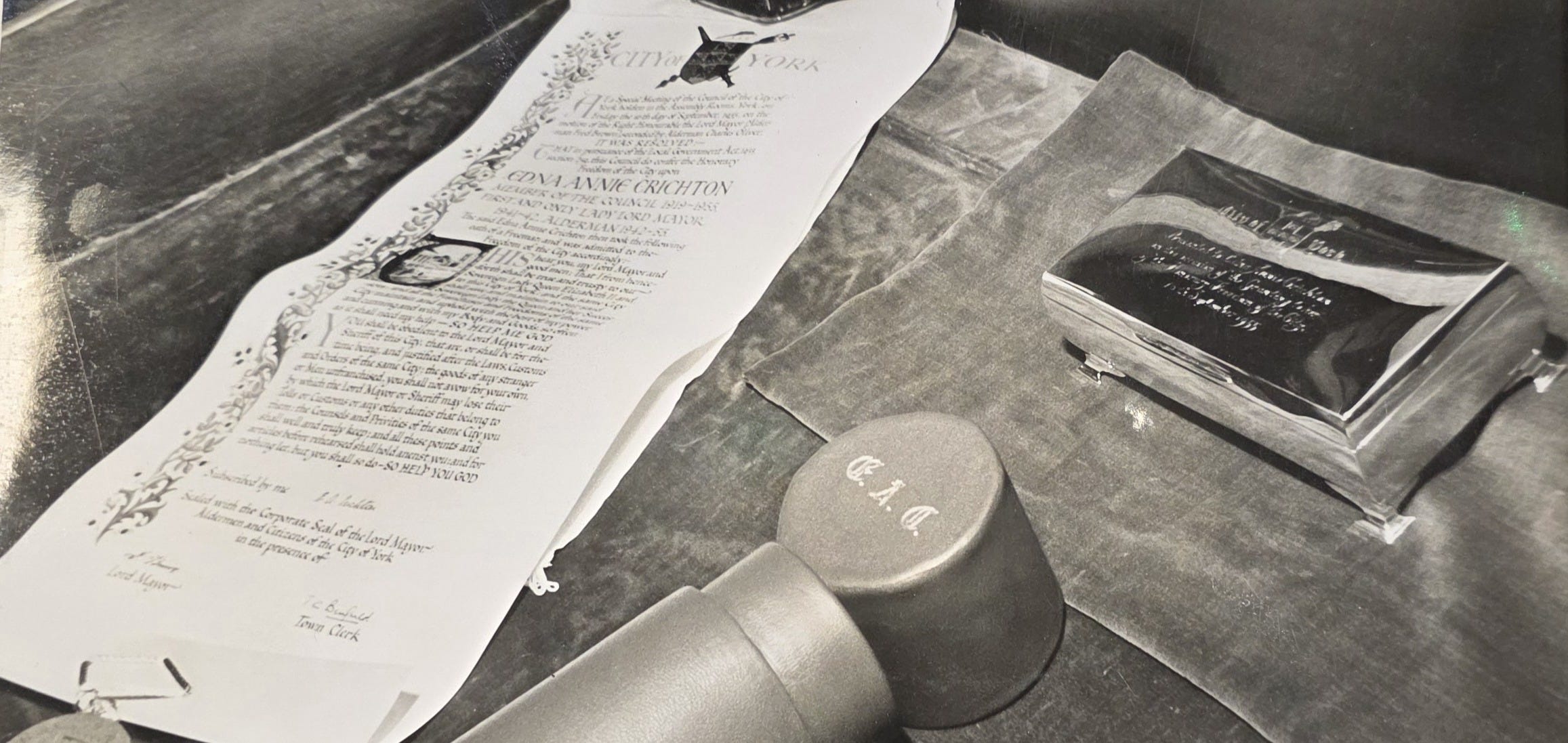
In 1955 Edna was not re-elected to the council. She was 79 and may have been relieved. On 16th September she was awarded the Honorary Freedom of York. She was only the second woman to be awarded this honour. (The first woman had been Mary, The Princess Royal, so Edna was the first female commoner.) Tributes were paid to her for her ‘calm and dignified’ approach during the war and for her achievements as Housing Chair.30 The ceremony was attended by a child from each school, and the Princess Royal sent her good wishes (they had met). Edna responded in her speech by thanking the Council for the gift of a scroll in a silver container. She also received a ‘silver box’ of ‘her favourite cigarettes’.31 In her speech she described how honoured she was to receive the Freedom as ‘an old woman’ and ‘one who is not somebody’. In the typed draft of her speech she speaks of her long years on the council sitting through many ‘wearisome’ committees. But she has replaced ‘wearisome’ with ‘lengthy’ (in handwriting) for the actual speech, as possibly less insulting to the other committee members. She laments the growth of party politics and the loss of independents. And she states that the element of council work which has interested her most is the ‘human side’.32
In her retirement in Clifton, Edna apparently enjoyed playing chess and ‘bridge, reading romances, smoking du Maurier cigarettes’ and visiting her friends the Morrells.33 She went to the cinema. (Clifton cinema, now Clifton bingo hall, was just up the road from her house.)
In May 1969 her daughter Vida, who had been living with Edna, died at the age of 67. Vida was buried in the Quaker burial ground at the Retreat.
On 3rd March 1970 Edna herself died while recovering from a broken hip in the Grove House Nursing Home. Her ashes were scattered on her husband’s grave in the Quaker burial ground. There was a well-attended memorial service at St. Olave’s Church. The address was given by her friend John Dronfield, the headteacher at St Peter’s School. In the eulogy she was praised for her: ‘lion hearted reaction to the raid in 1942’. He referred to the personal tragedies in her life and that going through these had enhanced her ‘understanding of the difficulties and misfortunes of her fellow citizens.’34
Her memory lives on
There was no second female Lord Mayor after Edna until 1961, twenty years later. Since 1942, there have been 16 female Lord Mayors out of 81 Lord Mayors in total. In later years however, this has evened out to 11 of 21 Lord Mayors between 2000 and 2021. (In 2017-18 the city’s civic party was composed entirely of women.)
While Edna Annie Crichton has no grave, she is remembered in other ways.
On 22 June 2017 the York Civic Trust placed the blue plaque on 30 Clifton remembering Edna as a City Councillor, as Lord Mayor and as Alderman and Honorary Freeman of the City. The plaque was unveiled by the then Lord Mayor, Barbara Boyce, who was accompanied by 3 former Lord Mayors: Janet Hopton, Ann Reid and Janet Looker (Janet Looker was Lord Mayor 3 times).35
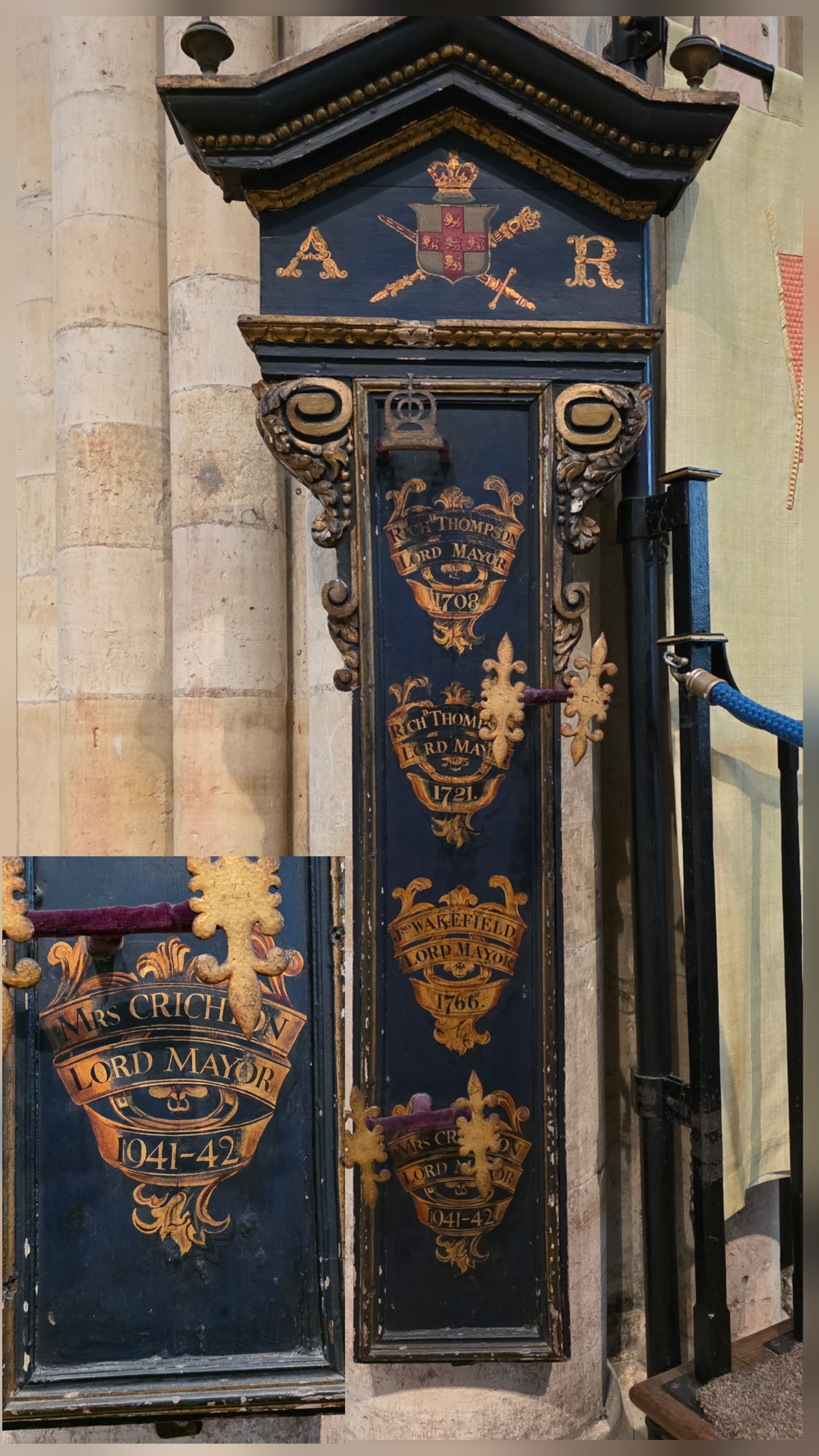
Edna’s name and the years of her mayorship are written on a sword holder behind the pulpit in the Minster, under the names of two (one twice) 18th century Lord Mayors.
Her legacy is, of course, continued by her grandsons and their families.
But, perhaps ironically, she is best remembered by the people of Clifton because of Crichton Avenue: named for her husband David Sprunt Crichton, but forever associated with Edna Annie Crichton, the ‘little woman with the heart of a lion’.36
Acknowledgements
I am indebted to, among others, the late David Rubinstein for the information contained in his Homage to Edna Annie Crichton and to Dorothy Nott for her lecture on Edna and for her support. I hope I have managed to bring a few different perspectives on Edna’s story with the additional use of other sources including censuses, electoral records and other public and archival records.
1881 Census Find My Past https://search.findmypast.co.uk/record?id=GBC%2F1881%2F4315449%2F00794&parentid=GBC%2F1881%2F0011443339
Dorothy Nott, Edna Annie Crichton York’s First lady Lord Mayor, Oliver Sheldon Memorial Lecture, 21 October 2025 https://www.sheldonmemorialtrust.org/lectures
David Rubinstein, Homage to Edna Annie Crichton, Quacks Books, 2013 pg 7
Find My Past Edna Annie Crichton 1911 Census https://search.findmypast.co.uk/record?id=GBC%2F1911%2FRG14%2F28411%2F0279&parentid=GBC%2F1911%2FRG14%2F28411%2F0279%2F2
Dorothy Nott, Edna Annie Crichton York’s First lady Lord Mayor, Oliver Sheldon Memorial Lecture, 21 October 2025 https://www.sheldonmemorialtrust.org/lectures
Sylvia Jane Dunkley Women magistrates, Ministers and Municipal Councillors in the West Riding of Yorkshire, Sheffield University August 1991 pg 153 https://etheses.whiterose.ac.uk/id/eprint/10246/1/364760.pdf
Yorkshire Post and Leeds Intelligencer 25 January 1921 https://www.findmypast.co.uk/image-viewer?issue=BL%2F0000687%2F19210125&page=4&article=124&stringtohighlight=david+sprunt+crichton+york
Housing Committee minutes, 16th December 1929 York Explore Archive Y/COU/5/10/4/2
Yorkshire Gazette 15 October 1937 in Sylvia Jane Dunkley Women magistrates, Ministers and Municipal Councillors in the West Riding of Yorkshire, Sheffield University August 1991 pg 155 https://etheses.whiterose.ac.uk/id/eprint/10246/1/364760.pdf
Joseph Rowntrees Funeral https://www.rowntreesociety.org.uk/joseph-rowntrees-funeral/
Ancestry, Edna Annie Crichton, 1921 Census https://www.ancestry.co.uk/search/collections/63150/records/29786154?tid=&pid=&queryId=ae5d8830-1a75-4c18-95b2-0f4a719c942c&_phsrc=PBK176&_phstart=successSource
Find My Past, Edna Annie Crichton, Electoral Registers 1920s https://www.findmypast.co.uk/search/results?sid=100&firstname=edna+annie&firstname_variants=true&lastname=crichton&keywordsplace_proximity=5&sourcecountry=great+britain
Find My Past, Edna Annie Crichton, Electoral Registers 1930s https://www.findmypast.co.uk/search/results?_page=2&firstname=edna%20annie&firstname_variants=true&lastname=crichton&sourcecountry=great%20britain&sid=100
Dorothy Nott, Edna Annie Crichton York’s First lady Lord Mayor, Oliver Sheldon Memorial Lecture, 21 October 2025 https://www.sheldonmemorialtrust.org/lectures
Find My Past, Edna Annie Crichton Electoral Register 1933 https://search.findmypast.co.uk/record?id=GBOR%2FER%2FYORK%2FER%2F1933-1934%2F0212_1&parentid=GBOR%2FYORK-ER%2F1644905
Diary of Mary S.W. Pollard 1930 to 1936 https://benbeck.co.uk/fh/transcripts/mswpdiary/mswp1930-36.htm
David Rubinstein, Homage to Edna Annie Crichton, Quacks Books, 2013 pg 17
Shipping Manifest White Star Aquitania https://search.findmypast.co.uk/record?id=TNA%2FBT27%2F1438%2F00%2F0014%2FP%2F0006F&parentid=TNA%2FBT27%2F1438000014%2F00157
Leeds Mercury, 23 November 1936, Find My Past https://www.findmypast.co.uk/image-viewer?issue=BL%2F0000748%2F19361123&page=5&article=082&stringtohighlight=edna+annie+crichton
Yorkshire Post and Leeds Mercury 10 November 1941, Find My Past https://www.findmypast.co.uk/image-viewer?issue=BL%2F0000687%2F19411110&page=2&article=029&stringtohighlight=edna+annie+crichton
York Evening Press 10 November 1941 in David Rubinstein, Homage to Edna Annie Crichton, Quacks Books, 2013 pg 20
Find My Past, Gloucester Citizen https://www.findmypast.co.uk/image-viewer?issue=BL%2F0000325%2F19411001&page=2&article=016&stringtohighlight=david+sturge+crichton
Raids Over York https://raidsoveryork.co.uk/raid8-29-apr-1942/
York Evening Press 30 April 1942 in David Rubinstein, Homage to Edna Annie Crichton, Quacks Books, 2013 pg 23
York Evening Press 5 May 1942 in David Rubinstein, Homage to Edna Annie Crichton, Quacks Books, 2013 pg 24
Edna Annie Crichton, Speech given on the presentation of Freedom of the City to William Temple, Archbishop of Canterbury, York Explore Archives CRI/4
York Evening Press 3 December 1946 in David Rubinstein, Homage to Edna Annie Crichton, Quacks Books, 2013 pg 28
York Evening Press 3 May 1955 in David Rubinstein, Homage to Edna Annie Crichton, Quacks Books, 2013 pg 32
Dorothy Nott, Edna Annie Crichton York’s First lady Lord Mayor, Oliver Sheldon Memorial Lecture, 21 October 2025 https://www.sheldonmemorialtrust.org/lectures
Edna Annie Crichton Transcript of a speech, 16 September 1955 York Explore Archives CRI/6
David Rubinstein, Homage to Edna Annie Crichton, Quacks Books, 2013 pg 35
John Dronfield, Eulogy in York Evening Press, 10 March 1970 in David Rubinstein, Homage to Edna Annie Crichton, Quacks Books, 2013 pg 32
York Press 3 March 2018 https://www.yorkpress.co.uk/news/16056002.yorks-blue-plaques-edna-annie-crichton/
John Dronfield’s Eulogy from HERSTORY.YORK WALKING TRAIL https://www.goodorganisation.co.uk/transcript.pdf